



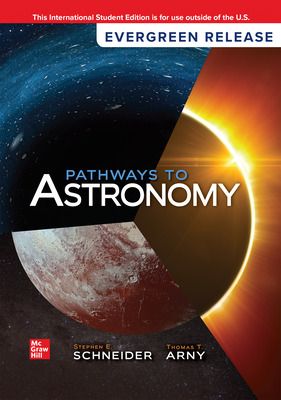
PATHWAYS TO ASTRONOMY (ISE)
Softcover
฿ 1,719.00
1,910.00
Discount 10 %
สามารถสอบถามเพิ่มเติมหรือสั่งไซส์/สี ได้ที่นี่

Book info
Barcode : 9781265226367
ISBN : 9781265226367
Size ( w x h ) : 0 x 0 mm.
Number of pages : 0 Pages
Year of print : 1 / 2025
Book category : ฟิสิกส์
Product details : PATHWAYS TO ASTRONOMY (ISE)
Pathways to Astronomy breaks down introductory astronomy into its component parts. The huge and fascinating field of astronomy is divided into 86 units. These units are woven together to flow naturally for the person who wants to read the text like a book, but it is also possible to assign them in different orders, or skip certain units altogether. Professors can customize the units to fit their course needs. They can select individual units for exploration in lecture while assigning easier units for self-study, or they can cover all the units in full depth in a content-rich course. With the short length of units, students can easily digest the material covered in an individual unit before moving onto the next unit.
PART I THE COSMIC LANDSCAPE
- Unit 1. Our Planetary Neighborhood
- Unit 2. Beyond the Solar System
- Unit 3. Astronomical Numbers
- Unit 4. Scientific Foundations of Astronomy
- Unit 5. The Night Sky
- Unit 6. The Year
- Unit 7. The Time of Day
- Unit 8. Lunar Cycles
- Unit 9. Calendars
- Unit 10. Geometry of the Moon, Earth, and Sun
- Unit 11. Planets: The Wandering Stars
- Unit 12. The Beginnings of Modern Astronomy
- Unit 13. Observing the Sky
- PART II PROBING MATTER, LIGHT, AND THEIR INTERACTIONS
- Unit 14. Astronomical Motion: Inertia, Mass, and Force
- Unit 15. Force, Acceleration, and Interaction
- Unit 16. The Universal Law of Gravity
- Unit 17. Measuring a Body's Mass Using Orbital Motion
- Unit 18. Orbital and Escape Velocities
- Unit 19. Tides
- Unit 20. Conservation Laws
- Unit 21. The Dual Nature of Light and Matter
- Unit 22. The Electromagnetic Spectrum
- Unit 23. Thermal Radiation
- Unit 24. Identifying Atoms by Their Spectra
- Unit 25. The Doppler Shift
- Unit 26. Special Relativity Unit
- Unit 27. General Relativity
- Unit 28. Detecting Light - An Overview
- Unit 29. Collecting Light
- Unit 30. Focusing Light
- Unit 31. Telescope Resolution
- Unit 32. The Earth's Atmosphere and Space Observatories
- Unit 33. Amateur Astronomy
- PART III THE SOLAR SYSTEM
- Unit 34. The Structure of the Solar System
- Unit 35. The Origin of the Solar System
- Unit 36. Other Planetary Systems
- Unit 37. The Earth as a Terrestrial Planet
- Unit 38. Earth's Atmosphere and Hydrosphere
- Unit 39. Our Moon
- Unit 40. Mercury
- Unit 41. Venus
- Unit 42. Mars
- Unit 43. Asteroids
- Unit 44 Comparative Planetology
- Unit 45. Jupiter and Saturn: Gas Giants
- Unit 46. Uranus and Neptune: Ice Giants
- Unit 47. Satellite Systems and Rings
- Unit 48. Ice Worlds, Pluto, and Beyond
- Unit 49. Comets
- Unit 50. Impacts on Earth
- PART IV STARS AND STELLAR EVOLUTION
- Unit 51. The Sun, Our Star
- Unit 52. The Sun's Source of Power
- Unit 53. Solar Activity
- Unit 54. Surveying the Stars
- Unit 55. The Luminosities of Stars
- Unit 56. The Temperatures and Compositions of Stars
- Unit 57. The Masses of Orbiting Stars
- Unit 58. The Sizes of Stars
- Unit 59. The H-R Diagram
- Unit 60. Overview of Stellar Evolution
- Unit 61. Star Formation
- Unit 62. Main-Sequence Stars
- Unit 63. Giant Stars
- Unit 64. Variable Stars
- Unit 65. Mass Loss and Death of Low-Mass Stars
- Unit 66. Exploding White Dwarfs
- Unit 67. Old Age and Death of Massive Stars
- Unit 68. Neutron Stars
Related products











Customers who bought this product Also bought this product
Review score from buyers
0 Full 5 Star
0 People
0
0
0
0
0

PATHWAYS TO ASTRONOMY (ISE)
Softcover
Normal price
PATHWAYS TO ASTRONOMY (ISE)
฿ 1,719.00